
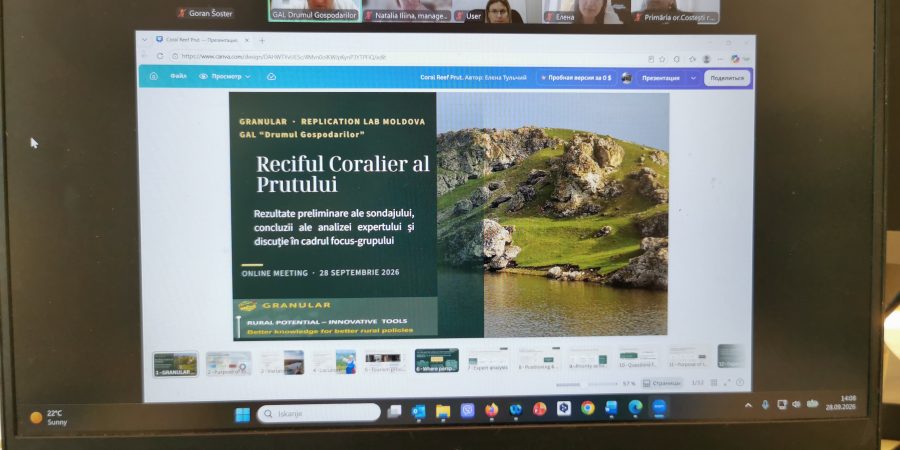
On 28 September 2026, the GRANULAR Replication Lab in Moldova, coordinated by LAG “Drumul Gospodarilor”, organised a focus group meeting dedicated to the future development of the Coral Reef of the Prut. The meeting brought together local stakeholders to discuss the results of extensive field research and, most importantly, how this evidence can now be translated into concrete action.
The meeting represented another important step in the work of the Replication Lab. Rather than simply presenting research results, participants were invited to validate the findings, discuss the challenges identified and jointly consider realistic priorities for the future.
210 voices providing a picture of the territory
The discussion was based on a survey involving 210 respondents, bringing together three complementary perspectives: 83 tourists, 87 local residents and 40 tourism service providers and other stakeholders.
The results show considerable potential for tourism development around the Coral Reef of the Prut. Visitors particularly appreciate the area’s nature, tranquillity and overall experience, while local residents strongly recognise the potential of their territory and generally support further tourism development.
At the same time, the research identified several areas requiring further work. These include the availability of information, tourism activities and products, accessibility, infrastructure, promotion and cooperation between local service providers.
This led to one of the central conclusions of the meeting: the potential already exists, but it has not yet been fully transformed into a visible, accessible and well-structured tourism offer.
Developing the product before promoting the destination
An important part of the discussion focused on what should happen next.
Participants agreed that large-scale promotion alone is not enough. The territory first needs to develop clear tourism products, experiences and service packages that can provide visitors with concrete reasons to come, stay and explore the area.
At the same time, the uniqueness of the Coral Reef of the Prut should be communicated more clearly. This communication should be supported by reliable and scientifically accurate information about its geological and natural heritage.
Several practical ideas emerged during the focus group. One is to involve educational institutions more actively, including adapting the “Guide for a Day” initiative, through which senior students could introduce the area to younger students, educational groups and potentially tourists. Participants also discussed training activities, educational and promotional materials and the possibility of developing a walking or adventure route through the canyon from Duruitoarea towards Horodiște.
From local partnership to wider advocacy
The discussion went beyond tourism development itself. An important question was how the knowledge generated locally can reach decision-makers at regional and national levels.
The Replication Lab is built around a strong bottom-up approach, involving the LAG, local authorities, businesses, educational institutions, service providers and other community actors.
The proposed advocacy approach therefore starts not necessarily with an immediate demand for policy change, but with making relevant institutions aware of two important facts: the Coral Reef of the Prut is a unique rural resource, and there is already an active local partnership interested in its sustainable development.
The next stage should include dialogue with relevant stakeholders and direct meetings where the local partnership can present its evidence, experience and vision for the territory.
A gradual approach to tourism development
The focus group also discussed the potential for attracting visitors from outside the immediate area.
Rather than moving immediately towards broad international promotion, participants supported a gradual approach. The first step would be to strengthen tourism products for visitors from Moldova, particularly Chișinău and Bălți, as well as neighbouring Romania. Once the local offer is better structured, promotion can progressively expand towards wider international audiences.
The Replication Lab’s own field research will remain particularly important. General tourism statistics cannot provide a detailed picture of visitors to individual rural attractions, making locally collected evidence a valuable resource for future planning.
Turning rural knowledge into action
The focus group provided a clear direction for the next stage: validate the evidence, identify priorities, shape concrete tourism products and experiences, strengthen cooperation and define responsibilities for future action.
The work around the Coral Reef of the Prut demonstrates the wider purpose of the GRANULAR Replication Labs – connecting data and research with the knowledge of people who live and work in rural territories.
For the Moldovan Replication Lab, the process is increasingly moving from identifying rural potential towards turning that potential into cooperation, economic opportunities and practical actions for the local community.
The activity was organised within the GRANULAR project, with the involvement of the PREPARE network and local partners in Moldova.
Results RL Coral Reef Prut